The Loinfire Club doesn't read.... Twilight

Twilight, by Stephanie Meyer

When 17 year old Isabella Swan moves to Forks, Washington to live with her father she expects that her new life will be as dull as the town. But in spite of her awkward manner and low expectations, she finds that her new classmates are drawn to this pale, dark-haired new girl in town. But not, it seems, the Cullen family. These five adopted brothers and sisters obviously prefer their own company and will make no exception for Bella. Bella is convinced that Edward Cullen in particular hates her, but she feels a strange attraction to him, although his hostility makes her feel almost physically ill. He seems determined to push her away ? until, that is, he saves her life from an out of control car. Bella will soon discover that there is a very good reason for Edward's coldness. He, and his family, are vampires ? and he knows how dangerous it is for others to get too close

The Chronicler feels she really needs to get some more horrible books to bash, or perhaps better books to gush over. Mediocrity is really quite difficult comment on and even more difficult to read. After a while the mind numbs to the dull prose and what nuggets of interest are only interesting in comparison.

Mrs Giggles wrote that Stephanie Meyer created "the most potent kind of pornography for teenage girls in Twilight - the Mary Sue epic love story." And, preamble aside, the Chronicler maintains that this assessment is the most succinct, witty and accurate assessment of Twilight possible and that anything she can add is really just flogging a dead pony. Elizabeth Hand dissects all four books with great wit and brevity... But the rambling habit never stopped me. Neither will the fact that Twilight has already received numerous awards (The 

Anthropologist remarked that she never heard anyone scream "Publishers Weekly Best Book of the Year" with that much horror).

Incidentally, the cover of Twilight is really pretty. Proverbs and pronouncements aside, it was in fact the reason why The Chronicler owns a copy of the book. That and there is something compelling about the blurb:

About three things I was absolutely positive. First, Edward was a vampire. Second, there was part of him — and I didn't know how potent that part might be — that thirsted for my blood. And third, I was unconditionally and irrevocably in love with him.

Of course, when you think about it harder there are holes to pick at and the promise of unconditional love is all well and good in concept, in quotes, but it is often makes for a perplexing – if not alienating – read. Dark, twisted obsession makes for a fascinating read, but the trap of romanticising it so often ensnares the author and the reader is presented a picture of dubious relationship practices as an ideal rather than a compelling perversion.

Isabella "Bella" Swan moves into Forks, which we are assured to be the most damp and overcast little town in all of America, and meets Edward Cullen, the sparkliest, most beautiful vampire ever. In the last quarter or so of the book, something resembling a plot kicks in and some vampire by the name of James decides he wants to hunt Bella for sport, but that is really inconsequential to the True Love that exists between Bella and Edward.

The opening chapters are interminable and shows again all the weaknesses of a first person narrative.* Meyer has an eye for incidental detail and one is torn from seeing it as clutter and seeing it as building a believable – if dull – character. Bella calls her father "Charlie" and her mother "Reneé". The Anthropologist theorises latent and repressed resentment or that they're "hip" parents who insist on being called their first names. However, Bella calls them "Mom" and "Dad" in speech and emails thus the "voice" of her narrative seems somehow... off.

Bella's description of her new truck makes me wonder if she's aware that the indomitable Toyota Pickup is foreign:

Plus, it was one of those solid iron affairs that never gets damaged — the kind you see at the scene of an accident, paint unscratched, surrounded by the pieces of the foreign car it had destroyed.

But much of Twilight shows a great blind spot in general knowledge, such as when Edward tells Bella that his favourite blood is that of a mountain lion and "Grizzly [Bear] is Emmett's favourite." He adds:

We have to be careful not to impact the environment with injudicious hunting. We try to focus on areas with an overpopulation of predators.

The Balance, ever the voice of reason and conservation biology, notes that this would mean nowhere. Whilst neither the grizzly bear nor the mountain lion is currently listed under "threatened" by the World Conservation Union, both populations are somewhat precarious. "Near threatened" is hardly a green light for vampires to start wrestling down mountain lions and draining them of blood.

But maybe the world of Twilight is completely different from our own when it comes to this and has a real problem with predator overpopulation...


The Anthropologist notes that Meyer seems to recycle common vampire tropes by substituting in less famous names in hopes that this obvious filing off of the serial numbers would give the impression of an original idea. Instead of Navajo skin-walker werewolves, she has them as Quileute. Instead of Michelangelo and Raphael Sanzio being inspired by Vampires to paint, it's Francesco Solimena, also of the Italian Renaissance. The new names doesn't make it feel more fresh or original.

Meyer struggles with creating the obliviously beautiful heroine – the ugly girl who is simple a pretty girl with glasses:

I should be tan, sporty, blond — a volleyball player, or a cheerleader, perhaps — all the things that go with living in the valley of the sun.

Instead, I was ivory-skinned, without even the excuse of blue eyes or red hair, despite the constant sunshine. I had always been slender, but soft somehow, obviously not an athlete. 

"Ivory-skinned" is in no way a derogatory descriptor. Neither is a soft slenderness. In fact, all one can get from the passage is that she is conventionally attractive. She tells us both her height (5' 4") and weight (110lbs), conveniently allowing us to work out her Body Mass Index, which we, of course, proceeded to do. (The Anthropologist was rather gleeful about this since she'd never been given the information to do this to a romance novel heroine before.)

It rather difficult to actually give Bella's claims of being an unpopular outcast any credence. She soon has a plethora of male admirers and multiple female friends (most of whom are nice but mildly jealous of her).

On the other hand, it is perhaps quite easy to see why she hadn't many friends back in Phoenix as she goes through her first day making unsympathetic snap judgements on the people who are nice to her:

When the bell rang, a nasal buzzing sound, a gangly boy with skin problems and hair black as an oil slick leaned across the aisle to talk to me.

"You're Isabella Swan, aren't you?" He looked like the overly helpful, chess club type.

It's not even that I don't like snarky people, but Bella's brand of sarcasm comes across as unpleasant, borderline misanthropic and not particularly incisive (or funny, for that matter). She is also utterly oblivious to the possibility that she may be doing something wrong in her inability to communicate and sympathise with her peers.

(Incidentally, we never do discover whether or not "Chess Club Eric" is actually member of any chess club – or if there is a chess club at this school – he is given this label by Bella and it is used forevermore.)

Meyer claims that Bella's sudden surge in popularity in Forks high school is based in part on her own ugly-duckling-now-swan university experience. Of course, there is quite a big difference between switching from one high school to another and from high school to university. Usually, the case of "stock surge," as Meyer put it, is caused by there simply being more people at college and exposure to a greater number of people. The Anthropologist also quips that Meyer's anecdote is probably coloured by the fact that she attended Brigham Young University, where the beauty is measured by willingness to become a happy housewife. (The Anthropologist would like to add that she was being very snarky at this point and doesn't mean it literally.)

Probable or not, it's immensely hard to sympathise with the self-proclaimed unattractive girl who finds herself being asked by three (not including the hero) boys to the "girls' choice spring dance." Which is really reason enough to reject them since they blatantly fail to grasp simple concepts (and will no doubt have trouble with concepts like "consent" later on in the evening.) Bella takes her new friends and admirers very much for granted. She doesn't even seem to care much about them and they start blurring together into this faceless, chattering mass, which really doesn't recommend the character to me.

The same applies to most of Twilight, there is a great distance between the showing and the telling. As readers, we're told repeatedly that Bella is clumsy to the point of endangering herself, yet we little evidence of this in her actions. I understand the need for comic hyperbole, but the "joke" of Bella's clumsiness needs to be reinforced with some actual correlation with reality. I don't know, she could get hit by a volleyball more. Or walk into a lamppost whilst reading. We're told Bella is bookish, yet she is rarely shown reading and it seems never to surface in her conversation – surely any seventeen-year-old who has wild imagination and a bookish way can come up with something more creative than "Bruce Wayne and Peter Parker" in an entire month. For that matter, "Bruce Wayne" is a stupid explanation for Edward's supernatural abilities since Batman has none; he's just really, really rich. 

I had decided to read Wuthering Heights — the novel we were currently studying in English — yet again for the fun of it...

I know I've odd opinions about the Brontës, but who reads Wuthering Heights "for the fun of it"? It's an immensely emotionally draining book. (Unless, of course, you find it alienating, messy and dull, which is another popular opinion.) It's really quite dark and unlike, say, Jane Eyre, it's quite difficult to overlook the dark bits – the murderous hero, the unapologetically selfish heroine... But perhaps this attitude to the events of Wuthering Heights will explain her later reaction to Edward's vampirism.


But yes, the vampires of Twilight, the main attraction... they are quite possible the least subtle ones this side of serious literature. They are aloof, never talk to any of the students and sit by themselves in their little huddle in the cafeteria:

[They] were all devastatingly, inhumanly beautiful. They were faces you never expected to see except perhaps on the airbrushed pages of a fashion magazine. Or painted by an old master as the face of an angel.

(At this point, the Chronicler hastens to add that she clearly doesn't mean any of the medieval masters...)

Not only that, but they all have:

dark shadows under those eyes —purplish, bruiselike shadows. As if they were all suffering from a sleepless night, or almost done recovering from a broken nose.

...which you'd think would crimp their perfect, perfect beauty. It's explicitly describes as being more like an injury rather than overly enthusiastic eye-shadow application. But clearly Bella (or Meyer) is of the opinion that abuse victims are hot.

The deathly pale complexion, unearthly beauty (despite adopted) and uniformly bruised eyes aside, they also don't eat. They all sit there with their food in front them, looking at nothing in particular ("away from each other, away from the other students, away from anything in particular as far as I could tell") and not eating. They then proceed to throw away their uneaten food. And this happens, we could but assume, every day. Wasting the food aside, it seems inane that no one has noticed this. Especially since I'm sure anorexia is quite a problem in high schools (one that is looked out for) and the girls look like "Sports Illustrated" models, which implies underweight to me.

I hope you're getting a full image here, dear reader: inhumanly beautiful, deathly pale clique with uniformly bruised eyes sit together, not looking at anything, not eating, every lunch time at the cafeteria. I wouldn't suspect vampires, but cult would be high on the suspicions list.


Bella and Edward stare at each other, a lot. Edward stares at her with a "hostile, furious" expression on his face. And she shies away from his gaze, but stare at him when he's not looking. This game of stares goes on for far, far too long. The blurb makes no secret of Bella and Edward's eventual relationship so it really begs the question why it can't cut to the chase, especially when the misunderstandings and double-meaning really gets on my nerves. 

Edward heavy-handedly hints at how very dangerous he is and the reader is in on the fact that he's a vampire, but Bella isn't and... suffice to say, the Belief Turnstile is badly handled. It's a very, very long time before Bella finds out that Edward's a vampire and the whole sequence lacks suspense (since the reader already knows he's a vampire and is impatient for the revelation) and momentum, let alone actual believability. Bella hears about vampires from Jacob Black, a family friend and then ends up googling it. She then ponders if Edward could be. Later, he confirms this... it's just dull. And never does she actually feel threatened by him.

Of course, it's never clear what Bella's worldview was, pre-vampires. She swallows the website wholesale and moves on to speculate whether the Cullens were vampires. She doesn't need to, well, fit them into an emerging picture of the world she lives in. If someone were to prove to me that vampires exist, then the next question is whether or not other folkloric creatures exist and which versions of the folklores are most accurate. Then is the question where they fit in the universe: Is there a heaven and a hell? Do we have souls or not? Etc, etc...

Bella's just incredibly uncurious. She asks Edward about popular culture vampires, but neglects to ask him about the three pages of Wikipedia reading she did.

I felt a spasm of fear at his words, and the abrupt memory of his violent black glare that first day… but the overwhelming sense of safety I felt in his presence stifled it.

Their relationship is described with self-contradicting hyperbole and never does the reader glimpse the "heart" of the relationship, how the two characters actually function together as a couple. Bella falls in love with him without really interacting with him in any meaningful way beyond stares (and they're not even meaningful stares, the sort the allegedly pierce the heart and make one feel truly understood) and a few words of cryptic conversation. We never find out the contents of her Edward-filled dreams, since she doesn't really know enough of his personality to extrapolate what interacting with him would be like (unlike he, who was probably busy listening in on every conversation she has via mind-reading). Besides his statuesque beauty – literally, actually, since vampire skin resembles marble in its texture and hardness – he seems to have little to recommend him.

The most remarkable conversation is this one, early in their relationship:

I couldn't remember the last time I'd talked so much. More often than not, I felt selfconscious, certain I must be boring him. But the absolute absorption of his face, and his never-ending stream of questions, compelled me to continue. Mostly his questions were easy, only a very few triggering my easy blushes. But when I did flush, it brought on a whole new round of questions. 

He asks her questions like "What music is in your CD player right now?" and what her favourite gemstone/flower/colour/book/movie is. It 's even likened in the book to psychoanalysis. It's baffling, since most hold these topics to be conversation starters, where there is an exchange of opinion and discussion as opposed to a one-sided interrogation. One could read this as how a vampire (due to being dead) is utterly unable to really experience real preference and opinion, thus is leeching of her vivid and exciting life experience, but it's not really the way it's presented to one. Plus, Edward does actually have opinions and is functionally the same as a normal human.

The Anthropologist posits that it's because the teenage female desires a teenage boy who inundate them all the questions like those on facebook and myspace, desiring to know all those pointless preferences like a "which angel are you?" quiz, because that is their standard of meaningful correspondence.


Meyer uses Edward's bloodlust as an odd metaphor for sexual desire – Edward's sexual desire is equated to his desire to drink (and kill) Bella – which gives the whole book an odd allegorical side, which Meyer explicitly point to. But it's a tightly-controlled-yet-overpowering desire which Bella can never understand, neither does she feel anything akin to it – really quite repulsive, outdated sexual politics, in my opinion, but it's found in trace quantities in at least half the romance novels on the market, so I'll not harp on that too much. Elizabeth Hand finds in Meyer "unrequited female erotic yearning", but it's hardly the case. There's nothing even vaguely erotic about Bella's yearning. She's a good girl. Her admiration of Edward, though isn't physical – or so she insists. It's what's behind the face, she tells her friend, she's fascinated by the idea of a redeeming monster.

But Bella (unlike Jane Eyre, for example) isn't the agent of his redemption, she's remarkably passive throughout the story. Edward is already well on the road to redemption (set on by Dr. Cullen) when he meets her. Pillywiggin goes as far as calling her the "meatbag" Edward wheels about the place and refuses to let talk. Edward notes that he feels the most "human" when around her, but it's never really explained what that means.

(Actually, Dr. Cullen's backstory is really odd. It takes him, literally, months to develop the philosophy to drink animal blood instead of human. Seriously. How thick is this founding father of vampire "vegetarianism"? In addition, after a few centuries of self-control, he manages to resist bloodlust so much he can work in a hospital.)

Still, telling her that she must stay absolutely still when he kisses her, or else, he'll accidentally kill her, seems a bit much.

There really was no excuse for my behaviour. Obviously I knew better by now. And yet I couldn't seem to stop from reacting exactly as I had the first time. Instead of keeping safely motionless, my arms reached up to twine tightly around his neck, and I was suddenly welded to his stone figure

Edward's declarations of his immense skull-crushing strength is weird:

"If I was too hasty… if for one second I wasn't paying enough attention, I could reach out, meaning to touch your face, and crush your skull by mistake. You don't realize how incredibly breakable you are. I can never, never afford to lose any kind of control when I'm with you."

With that kind of strength... well, surely he'd be accidentally putting holes into walls, breaking doorbells, stamping through floors... telephones must be a nightmare as he accidentally punches them apart with his fingers. But of course, this sort of strength only applies when with Bella (or alternatively, Bella is just made of tofu).

Speaking of kisses, the book also boasts of what Pillywiggen has branded the most unsexy kiss she's ever read:

He seemed unaware of his watching family as he pulled my face to his, lifting my feet off the floor. For the shortest second, his lips were icy and hard against mine. Then it was over. He set me down, still holding my face, his glorious eyes burning into mine.

Bella is rather frail, she faints at blood (especially inconvenient when dating a vampire) and later faints at Edward's kisses. She has a special scent that only Edward can smell (no, I don't know why, or how he knows this) though she is still immensely attractive:

"If you didn't smell so appallingly luscious, he might not have bothered." [...]

"I thought… I didn't smell the same to the others… as I do to you," I said hesitantly.

"You don't. But that doesn't mean that you aren't still a temptation to every one of them. If you had appealed to the tracker — or any of them — the same way you appeal to me, it would have meant a fight right there."

After Bella is told that she is to inform her father that she's going out with Edward (so that he has an incentive to bring her back), she promptly decides to not do so, since if Edward succumbs to bloodlust and kills her, she doesn't want to get him into trouble.

It's probably common knowledge by now and barely worth mocking, but Meyer's vampires literally sparkle:

His skin, white despite the faint flush from yesterday's hunting trip, literally sparkled, like thousands of tiny diamonds were embedded in the surface. He lay perfectly still in the grass, his shirt open over his sculpted, incandescent chest, his scintillating arms bare.

The Anthropologist has much snark concerning how this conforms to teenage female aesthetics, but it's really getting too easy...


There is something compelling about the lion-in-love-with-the-lamb trope, and Meyer does milk it for all its worth, but she doesn't let the story darken or deepen. Edward really isn't a very objectionable vampire. Vampires being harmed by holy water and daylight reinforces as metaphysical acknowledgement of their inhuman, inherently diabolical nature. By getting rid most of the traditional vampiric trappings, Meyer's vampires just aren't very monstrous. Or scary. 

There is nothing that isn't immediately forgiven by Bella. She isn't repulsed by the fact he doesn't drink blood, or that he has killed numerous people (admittedly serial killers, rapists and muggers) in the past in order to drink their blood. Her acceptance of him, this unconditional love, doesn't seem tested by his revelations. She takes it all in her stride. Monstrous, Byronic heroes work only if the heroine, the author, the reader, the rest of the cast, all acknowledge that he's actually monstrous.

It's telling, perhaps, in the phrasing of how Meyer says that Edward is based on Jane Eyre's Edward Rochester, because both "see themselves as 'monsters.'" It's the self-perception as monstrous, but Meyer, however sees Edward as a gentlemen, full of "olde-worlde charm." Of course, the Chronicler often finds that the world seems to reading a different book than her. Rochester is monstrous, in many ways. He was ready to commit bigamy (no small sin in Victorian England), he's got his wife locked up in his attic, madness aside, he's not really giving her any decent care or treatment. He also had mistresses (also no small sin in Victorian England). Jane is drawn to him, but she cannot forgive him and cannot marry him, so she runs away from temptation. But the point is, Rochester is a man weighed down by his past inhabiting a world that acknowledges his sinfulness. He's genuinely haunted by that past. Edward Cullen, on the other hand, flits about his teenage classroom. His decade of murdering murderers is brought up only once and never again, not even by Bella (seriously, that more than half her age spent drinking blood). Bella's absolute faith in Edward to control himself, to not kill her simply adds her mind-numbing naiveté and solidifies Edward as "just misunderstood."

Perhaps it's because he's so very well-controlled that Edward comes across as an automaton. Meyer speaks of "sacrifice" and she relates it to her college experience at Brigham Young University... It's as though she's not really aware that when most people write about "sacrifices" made for love, they don't mean "no sex before marriage" or "no alcohol at college." They usually mean things grander, more epic, shall we say. That Edward's sexual/bloodlust struggle is rather too dull to be placed at the fore of the book... well, we know he's not going to succumb. Bella's hardly going to die by his hand.... So where's the tension?  Bella doesn't have graphic fantasies of him gnawing her neck off and doesn't really actively tempt him beyond just existing.

Meyer also notes in the same interview that "Edward goes to great lengths so nothing bad happens to Bella, she is cared for so much. A lot of the book's appeal is the thought of being loved to that extent [...] There has been some antagonism from men about Edward. They are jealous because they don't want to try that hard."

Of course men don't want to try that hard. And no man should. It's creepy. Edward seems to do nothing else but stalk her (and hunt for food). He spends all his sleepless nights sneaking into Bella's room and watching her sleep, seemingly immune to boredom. (Pillywiggin theorises that Bella's a one-woman radio station in her range of sleep-talking, but I doubt that's what Meyer has in mind.) He stalks her, literally following her about and finding out where is by reading the thoughts of those around her. And this is all before they actually get together and declare their love and all that.

Yes, Edward can hear the thoughts of everyone around him (except for Bella) and has no qualms eavesdropping on her conversations with other friends and acquaintances. Bella simply cannot talk to anyone about him, cannot confide in anyone without him finding out. It's creepily invasive.  Worse, Bella doesn't have a problem with this. She doesn't feel as though her privacy was invaded, neither does she discourage him doing so beyond a jokey reprimand and she also doesn't feel that perhaps her friends wouldn't want creepy century-old vampire crawling all over their thoughts, making her come across as thoughtless and sociopathic. 

At the end of the day, Edward looks seventeen, but why is he condemning himself to year after year of high school education? This is never elucidated in the book, but as Mrs Giggles points out, "I can only shudder as I imagine how vapid Edward must be to enjoy being a permanent teenage kid." But he doesn't act like a seventeen-year-old. Hand describes him as "an obsessively controlling adult male," more father than boyfriend, and she's not far off the mark.

"You are my life. You're the only thing it would hurt me to lose."

I know, you're seventeen and you've no idea what to do with the rest of your life yet. But to anchor your entire existence on someone else is creepy and unhealthy. Has she not thought of her parents, her friends, her studies. Has no other hobbies that would be inconvenienced due to her vampirism? Perhaps it's because Meyer's so very de-fanged her vampires there's really not much choice. Being a vampire is just better. Eternal youth, supernatural strength, agility, perception and beauty.... There simply aren't any downsides. White Wolf's vampires, for example, have no creativity and all that they feel and create is merely a reflection of their alive years. Admittedly it's ridiculously angsty, but at least, it's a tangible downside. "I want to be a great artist, but I also love you, dear vampire" is a reasonable (if angsty) plot.

In conclusion, it's bad. And boring. Bella is infantile, passive and spineless. Edward is annoying, holier-than-thou and inhuman. As a bonus it also contains ideas about sex and relationships that I'd rather teenage girls didn't make into the stuff of their daydreams.


---

* A first person narrator is limited to narrating what he or she sees. It is through this character's eyes that the reader perceives the world – a great asset when the character is interesting and has an idiosyncratic world view, but also an immense weakness when the author imperfectly hides behind this persona and starts puppeting characters about or worse, when unintentional voyeurism, sadism or masochism is created through lingering descriptions of things.
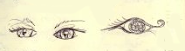
A dubious metaphor proved possible!

Hurray! The Chronicler's dictatorship of this blog is finally broken! Now her in-depth academical analysis and recounting of deranged ramblings can be sullied by a cheap visual gag.

We at the Loinfire Club have long mocked all references to the pebbling of nipples. None of us were quite sure how such a process might occur, what it might look like or why it isn't treated at the bizarre medical condition it must surely be.

But now, during my recent dirt-snuffling adventures, I have come across (ba-boom-cccch!) some genuine pebbled nipples, in the form of these two ladies.


For anyone who cares, they're both neolithic statue-menhirs on Guernsey; on the left is the St Martin's example and the Castel example on the right.

But anyway, I refuse to believe any romance-novel damsel to have breasts as pebbly as these two.


Pillywiggin

It has arrived...

Brisingr, by Christopher Paolini

The Royal Mail have kindly deliver to the Chronicler's house, a copy of Paolini's latest masterpiece, the third book in the four-book-Trilogy. It's a brick of a book, as the old Anti-Shur'tugal forums used to call it. It has yet to be opened and the Chronicler thought perhaps she should record a few thoughts on what she expects before she opens the book.

We're all aware of the very striking similarities between Paolini's work and that of Star Wars, but the reviews of both the books and especially the movie (example) have picked up on this. Whilst Paolini really can't write, he's not utterly retarded and is probably furiously trying to steer his plot away from any similarities. He's the master of retroactive continuity, rewriting the past and very reality of the setting to suit himself. We've seen him pull Great Revelations from bad-cliché-land throughout Eldest. He re-wrote an entire race (the orc-like urgals) in the last chapters of Eldest, a great Twist that, believe me, he had not even dreamt of when writing Eragon, and it shows.

Precisely what horrors will Brisingr bring? Well, besides the fact that I passionately hate the man for butchering my beloved Old Norse in the title (see here for full rant) and as much so for what he did in creating the Ancient Language.

So, what with Paolini actively working to topple ideas of what is going to happen next, some of the Star Wars ideas probably won't float. But I'm fairly sure there will be plenty of creepy love between Arya and Eragon, probably even more ignoring of Saphira as she is treated like an extension of her rider. I'm confident that Paolini's world-building skills won't have gotten better and he probably hasn't taken a course in medieval economics. His language will be even more overwrought and laboured than before. He may or may not have bought a new thesaurus but all the classic crimes of adverb abuse and adjective lists will no doubt be committed.

Oh, and random names from mythology will happen for no good reason.

The Chronicler should probably open the book now...

Cult of the Butcher God

Along time ago, before the forming of the Loinfire Club, when the Chronicler wrote as an ambiguously-gendered poster known as "Theo", there was a theory... The Chronicler is still so very fond of it that she wants to share it yet again as she opens the new chapter of Brisingr.

We were reading Eragon, late one night, after enduring the horror that is the film (very pretty, though) and came up with the following theory, which neatly explains the some of the silly economics ofEragon and what happened to the gods of Alagaesia (as Eragon does repeatedly mention the existence of nonspecific deities.)


A Butcher requires 1200 people
A Blacksmith requires 1500 people 
A Healer requires 1700 people
A Carpenter 550 people
A Tanner 2000 people
From: Medieval Demographics Made Easyhttp://i.ixnp.com/images/v3.49/t.gif


Yet Carvahall has but a population of 300...


The Cult of the Butcher God


The Humans of Alagaesia worship certain gods. One of the most important ones is The Butcher God. He has certain strictures, of which one can deduce by reading the book:


1) Thou shalt eat much meat; thou shalt not survive without eating meat.

This can be seen in Eragon and his family's need for meat to make it through the winter. Despite owning a farm and all its produce, they still need more meat from hunting and eat chicken for breakfast whilst their on the verge of not making it through the winter. Whatever happened to porridge? Or the eggs of the chickens. Or the milk from the cows.

This can also be seen in Eragon's raid of the Butcher when he runs away from Carvahall. He cares nothing for bread or other staple foodstuffs that don't rot in a day. He must have meat.

This also explains why Garrow's farm has such ridiculously small amounts of produce, yet still has excess to be sold off at Carvahall. They scorn the eating of vegetables. (They finished harvesting in about a day.)


2) The priests of the Butcher God shall be known as Butchers. There shalt be one in every settlement and they shalt be Clean.

This neatly explains why there is a butcher in Carvahall, when there is no need for one in a small farming settlement, where everyone can do their own butchering and own their own animals.


3) Thou shalt not kill your own animals. Take thou animals to the butcher so that they may be prepared in the Holy Way. Thou shalt then buy back thou meat.

This explains why the butcher, Sloan, has business. This explains why he has a ready stock of meat and even why he still has a stock of fresh prime cut meat to fill up Eragon's backpack when Horst demanded it, instead of having sold it all during the day.


4) Thou shalt cast aside the cheap cuts as they are unworthy of the Butcher God. Thou shalt eat only prime rump steak and the other good cuts of meat. Not even the dogs are fit to consume the unworthy meat.

It is obvious that everyone, including Horst, Garrow and Eragon, are devout worshippers of the Butcher God. Their concern over meat and their need for it thoughout the books can be seen.

This also explains the consumption of chicken for breakfast and Eragon's fondness of the simple fare of a hunk of meat boiled in salty water. This explains why Garrow isn't carefully boiling oxtails and offal for meaty stock for use in cooking.


5) Fish is not a Meat. Thou shalt not eat Fish instead of Meat.

This explains the curious lack of fishing near the sea or the enormous lakes (more on that later) of Alagaesia. They just don't need it. No one eats fish at any point, only ever cheese, meat or bread.

The second god of Alagaesia is the Smith God. These are his strictures:


1) Priests of the Smith God shalt be smiths. Only they shalt fix and make metal goods. For only they know the holy way.

Explains why every single village has its own smith and why Roran needs to take his chisel into Carvahall to get fixed. Of course, this is discounting the other meaning of chisel-fixing.


2) Thou shalt always take at least two apprentices.

Because one just isn't good enough.

Neatly explains why Horst needs two apprentices when he's working in one small village in the middle of nowhere, with nary a long distance journey horse in sight.


3) All thou horses shalt be shoed.

Gives Horst the business he needs when farm horses often don't need the shoeing due to only ever plodding on soft soil.


4) Thou must be a Master Smith to create complex machinery.

Explains why Horst is consulted for those damn mill parts. It's not a matter of skill, but of religious status. And that's never logical, is it?


5) All things shalt be forged and wrought. Even if they really shouldn't. Thou shalt love all things made of shiny metal. All things of worth shall resemble metals. Liquid and the appearance of liquid makes things more Holy.

This explains the poor starving family can spend money on trinkets, as Garrow repeatly produces not very much money from his pocket and tells Roran to spend it on a trinket. It also explains how the elf's helmet in the prologue is "wrought" out of amber and gold, wrought being a very specific action of folding and beating metal. Nigh impossible with something as soft as gold and as brittle as amber.

This also explains Chris' habit of describing things as "wrought" and "forged" out of something when its a mind-bogglingly stupid mixed metaphor that just doesn't work. Also, it explains Chris' other annoying habit of refering to things resembling liquid metals and gems. "Molten copper", "liquid diamond", "liquid silver"... etc...

This explains why Chris spends more time describing the sword (Ra'zac) than Eragon's angst about his dying uncle or the sheer horror of the death-strewn village. He spends far more time gazing on the arrows and spears.


6) Gold is the most Holy of all metals. All things of Importance shall be made of its brilliance. Next most holy is silver.

Explains why Eragon's armour is made out of gold, the very soft and heavy metal that is useless as practical armour. The helmet of gold in the prologue and assorted other inappropriate objects made from this metal.

There is also the Judgement God, who decides what is good and evil. He is probably often depicted playing chess, with black and white pieces. His strictures are as follows:


1) All Good things shalt be beautiful, shiny and white. All Evil things shalt be black, ugly and smelly.

This explains how Arya can smell of pine trees after months of imprisonment with the Urgals, who smell of fetid flesh.

This also explains the appearance and colour of everything in the book, such as the black arrows of the Urgals vs the swan-feather-fletched arrows of the elves. This explains the white baby on a spear and the black crow about to eat it.


2) Killing is neither good nor evil. If you are good, it is good to kill evil things and evil to kill good things. If you are evil, it is evil to kill both good and evil things.

The elves are fervent worshippers of the Judgment god. His duality can be seen rather prominently in their descriptions. They kill Urgals and other evil characters without reservation. They mutilate enemy corpses and kill envoys, and it's all okay, because they're Good and the enemy is Evil.

Finally, there is the Merchant God. He is less widely worshipped, but we can detect his cult in the major trading cities.


1) Taxes are Evil as they Oppress trade.

This explains why the Empire of Galbatorix is evil, despite having no other obvious act of oppression. Taxes are evil in the eyes of the Merchant God, and that is why the Empire must be deposed.


2)Thou shalt keep records of All thou transactions on Parchment.

This explains why everything is written on parchment instead of paper. (Parchment being expensive things made out of animal skins and paper being the cheaper stuff made out of wood chips and bark.) This also explains why records have been kept about the selling of Acid-Oil to the Ra'zac, which really has no reason to be on records anywhere. Empire owned ships, shipping to locations of the super-secret hideout of the Ra'zac shouldn't really leave a paper trail, yet it does.


Cult of the Farmer God

Thus are the strictures of the Farmer God:


1) All farms must be as far from cities as possible, so as not to be tainted by their civillisation.

Explains why there appear to be no villages or farmhouses or fields near cities. It also explains why Carvahall, little village at the edge of the great and glorious Empire, is featured on the map of it. It is a farming village furthest away from the cities, therefore it is becomes a site of pilgrimage and holy importance. Hence all the traders travelling there every year, why else would they visit? After all, villagers from a community with its own smith and tanner - thereby usurping all possible business from visiting tinkers - should be travelling to a market town yearly instead.

It also explains why Garrow's farm is a whole ten miles away from Carvahall for no real reason.


2)Thou shallt sell your Produce to the first trader thou meetest who will buy it. Thou shalt not hold out for a better deal.

It explains why Garrow sells his produce to random traders instead of travelling to a market town where he would set his own price.

It also explains why Eragon only manages to sell his horse for "a few coins", when it should be worth quite a lot of money, as horses are. (Horses are worth something in the ball-part of 300-600g of silver.)


3) Thou must pick a variety of crops on the same day. Thou shalt pick from each of your crops on each day of the harvest, for all are equal in the Eyes of the Farmer God. And thou shalt store it in a Holy Place.

Explains why Garrow and his helpers pick a little bit of everything: "last of the barley [...] prickly-vined squash, the rutabagas, beets, peas, turnips, and beans" (p.21, Eragon, hardback) all on one day. They should have more produce than that, so, if we give them the benefit of the doubt, they're using some mighty interesting picking tecniques.


4) All produce of the farm is holy in the eyes of the Farmer God and must be preserved for as long as possible. Eat of cheese and bread, the holiest product of the Farm.

This is why they carefully preserve everything for no reason and then neglect to eat it at any point. Or even think about eating it.

This explains why they only ever eat bread and/or cheese, when the characters of Eragon are not hunting. They do occassionally eat porridge or other foodstuffs, like that cherry pie of Eragon's (cherry pie is holy because it contains preserved cherries), but mostly, it's just bread and cheese.

It also explains why Eragon's bread can last over two weeks in the desert.

This also explains why Eragon feels the need to preserve Brom's body. And where Eragon has seen a mummy before (cf. the nitpick of Garrow's description). The Farmer God acts as the God of Death, or at least, death rites, in the bizarre culture of Alagaesia.


5) Thou shalt not improve thou fields with fertilliser or irrigation or any such other unnatural acts.

This explains why there is so much dry grass around Carvahall which should be irrigated and fertillised into good farmland and thus producing amounts which could last them through winter without supplementing. Hence also Garrow and other farmers not needing to have a mixed farm (the most logical sort of farm to have in case crops or animals of one variety fail). Of course, we can assume this is a world where crop rotation hasn't been invented yet.

Not wanting fertilliser would mean not needing to keep animals for that ever useful byproduct. 

Moon Shadow, continues, part four...

Bonegeek: "Are you sitting comfortably?"

Wiping my hands on the skirt of my fitted kirtle, I flung the door open.
The Pedant: "How do you fit a kirtle? It's a shapeless, loose garment."

He had the sexiest voice I'd ever heard. The Star Goddess herself would be weak in the knees with his voice.
The Chronicler: "No, she wouldn't. The Star Goddess is made of tougher stuff than that."
The Pedant: "She doesn't have knees."
Big L (mistaking him for the hero): "She's seen him jerk off in a box."
The Pedant: "What you need is not a prayer or a summoning spell, it's a personal ad."

A face like a fox, angles and laughter.
The Pedant: "Angles plus laughter does not equal fox!"
The Anthropologist:It's a mokosh on his head."

Eyes the color of turquoise stones and just as bright. They very nearly matched the unusual jerkin he wore.
The Balance (who allegedly has fashion scent): "Ewww!"
Big L: "It's always about the jerkin..."

(The Chronicler notes that this seems to suggest fashion-wise, this scene is somewhere in the Renaissance.)

Turquoise leather wasn't something I'd seen before...
The Balance: "That's because it's tasteless!"

... but if designers saw how this man wore it, blue jerkins would be all over the streets.
The Pedant: "Turquoise is not blue!"
Bonegeek: "I think I need to make some turquoise armour now."
Ramble and  diversion about Maelstrom and Bonegeek's desire to get some turquoise marriage armour.

"come in," I said, warmly, "No, the position isn't filled."
The Anthropologist: "Dodgy comments..."
The Anthropologist: "He's wearing a turquoise jerkin, he has to be trustworthy!"

"I hadn't realized from the ad," he said, "but you're a Love Wizard, aren't you?" [...]
Not stupid, then. "What gave it away?"
The Pedant: "Because she's only wearing a kirtle."
The Anthropologist: "Because she has a heart in her pentagram."

Oh, my flier had finally found the guy I needed, the guy I wanted.
The Pedant: "He's literate."
The Anthropologist: "On the bright side, we haven't had any I'm not a Slut moments."

I sent a mental kiss of thanks to the Star Goddess.
The Anthropologist: "Who didn't appreciate it..."
The Pedant: "and washed her face afterwards."

Retrieving the
Wabizi hand mirror from the end table, I settled next to him.
The Anthropologist: "Is that a second wave feminist hand mirror? The ones you use to inspect your own vaginas with?"
The Pedant (in some sort of flashback): "Middle-aged muff!"

If he passed the mirror's test, I'd have the perfect partner. Handing him the mirror, I said, "Look in the depths for a minute while I ask you some questions."
The Anthropologist: "Can you try to find my clit?"

The mirror reflected a truth for him nearly immediately. He had strong magic. [...] He was touching the face of a woman, both gazes filled with an intense love. She was beautiful. Her chestnut-colored hair was twisted at the top of her head.
The Balance: "Like Palin."
The Anthropologist: "Yes, yes, like Palin."

Wispy tendrils had escaped, and they framed her high-cheekboned face.
The Anthropologist: "Like Palin."

Her eyes looked kind.
Bonegeek: "Not like Palin."

"This is amazing magic," he said. "I've never heard of such a thing."
(The Chronicler wonders why, since he lives in the same bloody world setting. Is he part of the underclass? The unmagical masses? Who knows?)

In the depths of the glass, I watched as Fyord presented a box made of rosewood to the beautiful woman.
The Anthropologist: "It's a bomb, isn't it?"
The Pedant: "It's a baby's leg."

A fire crackled in a bedroom...
Big L: "We need to clarify this to be a metaphorical fire..."

...sending cozy shadows dancing across huge tapestries. Bathed in the light of flickering flames, the largest tapestry depicted fair maids picking daisies form a huge field of wildflowers while tall hounds stood at their sides.
(Tapestries are expensive things, dear reader, even today. It rather undermines their later claims of poverty and financial problems.)
The Anthropologist: "I'm making that a new category for Housekeeping fetishes!"
Big L: "You can't ... you're trying to kill us with the sips we'd have to take for that?"
The Balance: "She can, she's got the book."

Lying on a tall four-poster bed made of cherry, the woman wore a filmy gauze of virginal white. More relaxed, Fyord lay naked beside her, holding her hand. She looked ready to bolt...
The Anthropologist: "That's not a good sign."

He did it again, getting closer to that ticklish spot beneath her arm.
Bonegeek: "Oh, how erotic..."

...she picked up a pillow and bopped him over his head.
The Anthropologist: "And then beat him to death with it. Dear God, please!"

He ran his hand over her stomach, her ivory thigh.
The Balance: "She's only go one leg... it's a very expensive prosthetic."

She quivered under his touch, but fear wasn't on her face. Anticipation was.
The Balance: "It's literally there, sitting. It's a little imp by the name..."

On the love seat next to me, Fyord placed his hand over the glass protectively. "That's my wedding night," he said.
Bonegeek: "She's a voyeur."
The Chronicler notes that it's quite an invasion of privacy to look into the memories of a job applicant. Why can't she just ask him questions like a normal person? This is a setting that awknowledges "brainscans" as creepy, but somehow when you're doing it through a mirror and it's the heroine doing it, it's perfectly alright.
The Anthropologist: "This is a lot quicker than installing security cameras into everyone's houses."

From this bed, a tiny kitchen could be seen.
The Anthropologist: "Good housekeeping fetish!"

This image must have been from that morning, because Fyord was wearing his unusual turquoise jerkin...
Bonegeek: "I should hope significant time has passed, since she's thick with child."
Big L: "It could be magic semen."

"You love her, don't you?" I asked, knowing the answer before I heard it.
"With all my heart. Ceara's brother gambled away the family fortune..."
The Anthropologist: "So you have mindrape magic of many varieties, but you choose not to use it for anything useful. Like finding that rapist, instead you go off and pry on other people's honeymoon night."

"Gambling terrorizes some people," I said. "It's an addiction, like alcoholism."
"Can you treat it?" he asked with a sudden rush of hope.
"No," I said, my mind working the problem as it always did.
The Chronicler: "Because no one has asked her this before and she's thought about it before."

"Addictions are hard to treat. Wizards can Sense the illness, we can see the disease in the molecular structures of the cells, but we can't change the cellular structures."
The Balance (pained): "You can see gambling in the cellular structure..."

I looked across the room thinking with frustration of the various addicts who'd sought my help. It didn't matter what they were addicted to – alcohol, drugs, sex, gambling – I couldn't help them.
The Pedant: "But you think a Love Mage would be able to help with sex addiction."
The Chronicler: "But why would you go to a Love Mage for addiction? Maybe you could try a Addiction Mage..."

"Perhaps someday..."
There followed here an explanation about hyphens and ellipsis, how they have complicated relationships across the pages of these books.

"Then you see I need a job, a profession. My parents and I decided a long time ago to ignore my magical aptitude and focus on the family business. I've been trained in banking and investment..."
(The Chronicler: "Yes, this is the pseudo-fantasy pseudo-Renaissance setting with half-orcs, brownstones and banking and investment banking firms.")

...but Ceara's brother... after he did with my signature, well, I've been blackballed from any of the money careers."
The Anthropologist: "Can't he just report the bastard and clear his name?"
Big L: "You have seen the Police in this setting."
The Pedant: "They're only interested in cum-covered hoboes."

"I'm a Tan," he said, his dark hair hanging in his eyes.
The Anthropologist: "That's the lamest magic colour ever."
The Pedant: "Is it better or worse than brown?"

"I can't hire you," I said. The breadth of his shoulders gave me so many reasons to want to hire him.
The Chronicler: "I can only think of one there."

"But you've found your heart's mate. If you take this job with me, the love of your life will be jeopardized. You don't want to put your relationship with your wife on the line for this, believe me."
"But she wants me to get this job as badly as I want it. We have a strong relationship."
Big L: "Waspor would approve of strength."

"Neither of you understand of a Love Wizard's assistant."
Big L: "I think we can guess."
The Pedant: "Maybe she needs love, as a love wizard."

"We didn't' know what kind of Wizard you were, but it's such a respectable line of work...
There are giggles over the word "respectable".

If only he weren't so happily married. "Fyord," I said, taking his hand in mine. I worked hard to ignore the chemistry of his cells whispering to mine.
The Balance: "What? Are they reacting? Fusing together into one horrible mutant?"

If you were to take this job, you and I would have sex frequently [...]It's true that many times you'd think – you'd feel like – you were making love to your wife. Those times probably wouldn't hurt your relationship."
The Chronicler: "Because if you're fantasising of someone else whilst having sex with your boss, it doesn't actually count."

"But there're other times when you'd have to lead the spell. During those times, you'd know exactly who you were having sex with...
The Anthropologist: "Because all the other times, I'd be drugging you to the point of oblivion."

...Very few human relationships can withstand that, and from what I've seen of you in the mirror
...
The Chronicler: "What did you see? Some generic love scenes? There was no personality developed there?!"

...it would kill you and your beloved."
The Chronicler: "Why can't she trust him and his wife to make that decision? Themselves?"
The Anthropologist: "To be fair, most people would argue that having sex with someone else ruins your relationship."
The Chronicler: "True, not everyone has an open relationship... but I'm sure Dan Savage will beg to differ."

... and I wished I'd found him first.
The Chronicler: "There you go. The true reason she doesn't want him is because she can't do with just sex and wants a lover instead of an assistant."

Fyord sat silently for a moment, staring at his hands as if they could help him.
Big L: "It's weird, I feel like I have cum on my hands."

"I need a job," he said finally.
The Anthropologist: "I can sweep the cum off the floor for you when you're done..."

"Fyord, I'm a Love Wizard. I fix relationships – not ruin them."
The Chronicler: "Curious how we're on page 26 and we still don't really know what she means by that."

"I have a friend at the local Guild who might be able to guide you toward a more appropriate apprenticeship."
The Chronicler: "Maybe one in which you work in an environment where everyone wears a mask with your wife's face painted on it. Because you really shouldn't be talking to anyone else... but as long as you think you're talking to your wife. It's all okay."

"That might help," he said. "I'm looking into every possibility."
Big L: "Not looking very hard, clearly."
The Pedant: "We're back to the fact that she needs a personal ad." 

"Also," I added a warning, "Ceara is due within the month."
He looked at me and blinked. "No," he said. "She's due in two months time."
"I saw her only through the mirror, but I Sensed she's due imminently...
The Chronicler: "Imminently =/= a month."

Love Wizards deliver a lot of babies, and I'll happily deliver your child...
The Chronicler: "Because I'm that good. I see her through a mindrape mirror and I can tell... And more importantly, is there anything she doesn't do?"

He'd been so damn perfect. Grabbing the right hormones from his pituitary and his adrenal, pulling proteins from his blood to make love potions would've been so much fun.
Bonegeek: "Because biochemistry makes her hot."
The Anthropologist: "And makes us bleed."

Now I neede to make a new flier.
The Pedant: "Is it going to be described all over again?"

The Loinfire Club doesn't read... About that Night

About that Night, by Jeanie London

The plan is simple. Julienne Blake will use self-hypnosis until she's discovered the sexy woman inside, then she'll seduce Nick Fairfax during an unforgettable night. And with a tantalizing performance for an audience of one, she does just that. But her sensual plan seems to have worked just a little too well, because Nick is begging for a return engagement.

Nick has never met a woman who could capture his attention so completely as Julienne has. Her risqué moves have him pursuing her all over sultry Savannah just to be alone with her. But he's not a long-term kind of guy, so his desire to extend this passionate affair has him completely baffled. Somehow he has to convince her there's more than that night between them....


The Chronicler will get back to the joys of My Fair Viking, no doubt, but first just a brief summary of the horrors of About that Night.

The Chronicler admits the use of the word "horror" is largely unjustified; the book was by and large quite s quite dull. The sex scenes were tepid, the choice of words routine (pebbled, check; turgid, check; suckled, check; use of sex to mean cunt, check) and really, even at less than two hundred pages, the London is distinctly running thin of ideas. The book smacks of the sort of three-year-old naughtiness, back when it's edgy to say "damn" when no one's looking.

But a reader who buys a book marketed containing hot, steamy sex (it is a "Blaze," after all) should really be less easily shocked.

(Or perhaps this all speaks of the youth of today being rubbish. Who knows? But Description Inflation is always a problem that haunts us all...)

London is far too fond of the word "naughty." It comes across as childish, especially from a woman who is three decades in age. Admittedly, that's her theme, but the words "naughty boy" elicits not a the mental image of some unrepentant playboy, it reminds me only of bad governess fantasies and that scene in Child in Time. Really. There is nothing remotely sexy about "naughty boys."

Jules (or Julienne) self-hypnotises. Yes. She repeats uninspiring phrases to herself repeatedly to condition herself to be more "naughty", and the reader has to suffer with her as London threads these phrases in italics throughout the narrative.

Naughty girls feel good about being naughty.

The Anthropologist thought this was a novel about a really sexually repressed woman discovering herself, fighting the expectations of a sexually conservative (probably quite religious, this being set in Savannah, Georgia) society around her. But there is no evidence of this. If anything, the heroine (or the author) has so completely internalised her "nice girl" attitudes that there are not expectations for her to defy and confound besides that of her Uncle Thad (but we'll come to that.) No one even raises an eyebrow over Risqué Theatre, a building allegedly festooned in plaster phallus-wielding cherubs (also an unsexy image, seraphim maybe, but not cherubs. I'm not sure any world of politicians capitalising on the fundamental interest humanity has in sex can really justify government funding for this. Is there no one who thinks its tasteless and pornographic in all of Savannah? In a society so comfortable with its own sexuality, why is Jules so very uptight about hers?

The Chronicler also categorically state here, dear reader, that there is nothing remotely sexy about winged children with erections.)

Where is she getting her "good girl" ideas from? Maybe it's just Uncle Thad and she really has no other friends, thus giving him plenty of space to instil his ideas of womanhood into her. Jules doesn't need to escape the judgement and hypocrisy of the tag "good girl", there simply isn't the chorus of condemnation needed to create that atmosphere. Jules' friends and students and colleges all cheer her on and even the scandal that looms towards the end of the book over her sleeping with Nick is really rather tame. Hardly anyone is scandalised by it; instead the campus coos over how sweet and wonderful it all is. I suppose London has to construct and environment that Jules can later be comfortable in, but it results in creating a heroine with seemingly completely groundless neuroses.

Naughty girls feel naughty.

Jules is, frankly, stupid, when it comes to trying to self-hypnotise herself into self-confidence. For starters, she decides to unleash her inner sex kitten on one man and only man – Nick Fairfax, the man she has stalked for years (technically she's only obsessively read all his articles, books, theses and know about all his projects). This plan is ever so doomed to trample on her poor, poor ego if this book was set anywhere other than RomanceNovelLand. After all, whilst he has a "naughty boy" reputation, he might not be into her type. He might be having a bad night. He might have already made plans. Who knows? But the point is, it opens her up to the very real possibility of rejection and rejection for reasons that have nothing to with her. Hanging all her hopes of self-confidence and self-discovery on Nick flirting back seems unwise, to say the least.

Naughty girls talk the talk.

She is naive to the point of oblivious, especially since she allegedly regularly visits the Risqué (for architectural appreciation, I'll have you know) and has a saucy-speaking stylist. She is ridiculously surprised that phone sex involves masturbation:

"Touch yourself, Jules." [...]

Julienne lost her fragile hold on her growing confidence. Poof. [...] She supposed she should have seen it coming. After all, she was playing naughty with a man who'd honed the concept to a science.

Phone sex really isn't that scandalous. The whole business of Jules running into something and getting entangled deeper than she expected is tedious and rather insulting. I suppose it boils down to "nice girls don't ask for sex", but this never played with in the novel. It really just reinforces the ideas, if anything. "I dress in really provocative clothing and then flirt with a man with a reputation, after a sex show might lead to him trying to get me in bed? I couldn't have guessed." "You mean trying to arouse someone by talking sexy to them on the phone might lead to masturbation? I'm so surprised I get shocked out of my self-hypnosis!"

"I don't see what can be accomplished by making our relationship public? What's the point?"

"To broadcast we like kinky sex."

Dear reader, you misled by the above throwaway line that there is anything other than vanilla sex between the protagonists. There is talk of exploring fantasies about halfway and the Chronicler thought we might dabble in... no, just no. There isn't. London has no idea what she's writing. Maybe she thinks "kinky" means "really hot." The closest they get is the use of a sex swing, which whilst unconventional doesn't qualify as "kinky."

Nick wonders about women-who-you-marry and women-who-you-shag-and-leave. Whilst I'm really not that keen on secret-identity plots this book could actually have benefited from one, because his wondering over the woman is silly when he knows, frankly, both Jules (the naughty girl) and Julienne (the unsexy professor). He knows both of them and sees them work in their capacity, both inside the bedroom and out. 

Most of the self-agonising comes from Jules wondering about how to reconcile the fact that she's now self-hypnotising herself to be with Nick. She thinks that it's a Deception and it makes her an evil woman. Equally she's lying to Uncle Thad as he disapproves of any possible relationship between Nick and herself (EVIL!)... but the argument that self-hypnosis is an external force that obscures the "true self" is somewhat odd. As the Anthropologist pointed out, that makes sentences like this possible: "Oh, I started going to Yoga class and then I met this guy. But he doesn't know the real me, the pre-Yoga me that isn't as calm and flexible. I'm deceiving him!" or the more extreme: "I'm bipolar and I take mood-stabilisers, but I shall never know True Love and no one can possibly know the Real Me that I'm suppressing!"

Incidentally, these neuroses over her own are cured by Nick telling her (talking to her ex, who's the a professor of hypnotherapy) that hypnosis can't make you do anything that isn't "in you" already.

Seriously. It's at the beginning of every book of the subject. A big warning sign to all who think they can use hypnosis to convince a stranger to kill their enemies for them. It's all about giving the control back the patient, not taking it away, accessing inner selves and resources and all that. How can she miss it?

And having sex. Which proves she's actually a passionate woman, deep down. The Anthropologist thinks she's really just a very lazy woman and blames the whole nice/naughty dichotomy for her failure to quite a dull five-year relationship and actually do anything worthwhile with her time.

There are minor wtf?! moments that reminds the reader that this book isn't set anywhere near reality. This is a world that takes active tabloid-sprawling interest in the love lives of its preservation  architects. This is a world where it's unusual for graduate students to be used as a source of cheap labour (seriously, ever spoken to an archaeologist? A biologist?) and instead they hire random, seemingly untrained, locals. This is a world where a radio play called Hush Hush Honeys about an illicit, yet idyllic, love affair is the most popular thing on a student radio station named "Rebel Radio." This is a world where nepotism is perfectly acceptable and normal. This is world where snogging behind the bleachers qualifies as a naughty high school fantasy, where no one complains about students being made to work in a cock-studded theatre (seriously, it's America. Land of Abstinence Education. Surely some interest group will pick up on it.) This is a world without standardised data sheets (yes, this surprises us). This is a world where your professor's uncle can hijack the lecture and tell instead a random unrelated, but cute anecdote about your professor as a child (without anyone complaining that they'd really rather things went back on track. Like really. It might be useful.)

But really, what gets me the most the Great Plot Revelation: the hero and heroine conduct their super secret torrid affair, really rather badly. There is then the radio sensation that is Hush-Hush Honeys, about a pair of illicit lovers named Darling and My Love that seems eerily akin to their affair.

"Damn. That sounds like a guided tour of our weekend. We should check our clothes for surveillance equipment."

Who would go to such efforts to tacitly expose (or threaten exposure) their rather sedate sexual escapades? Is it the desperate debt-worn student who runs Rebel Radio and can benefit from the programme's phenomenal success? Is it Jules' bitter ex who wants to tear apart the couple by threatening exposure and thus shaming the hussy into getting together with him again?

No, it's Uncle Thad. The man who raised Jules himself. His source was listening to their phone conversations which he taped. He didn't just listen to some idle chatter and suggestive weekend plans. He was spying on their phone sex. And he didn't just end up listening to them out of a morbid and masochistic curiosity, a sort of inability to press the stop button when realised what the voice mail accidentally picked up. He listens to all their conversations, repeatedly to write the scripts of Hush Hush Honeys.

And instead of being horrified and saying something along the lines of "I understand you did this because you care. I love you, but I really don't think I can face you right now. And I'm moving out," Jules swiftly reconciled herself (after a brief bout of shame and mortification) with Uncle Thad and is understanding of his motives. He made her fling all about him and his relationship with her (as though everything in her life was about him) and then claims that he's actually letting her go.

His admission filled the ensuing silence with such richness of emotion that Nick had never before seen the like. Jules seemed to melt before his very eyes, her gaze suddenly bright with tears. She lifted trembling fingers to her mouth and blew her uncle a kiss. With a wink, he pretended to catch it in some private game. A charming little girl and her devoted uncle.

The whole confrontation scene is riddled with unintentional creepiness.

...as long as his dating Julienne hadn't harmed her relationship with her uncle...

No, Nick. Your dating Julienne doesn't and shouldn't harm her relationship with her uncle. His listening to the two of you having phone sex repeatedly, however, is a different matter altogether.

I can't really explain as well as Uncle Thad himself why he did it:

"I didn't write the serial to throw you to the wolves. I wrote it because I couldn't see another way of getting you both to wise up. You seemed quite content to treat your relationship with very little respect, like you were conducting some sort of sordid affair. I hoped if other people vied it with an equal lack of respect you might just come your senses."

And at the end of the day, the book doesn't celebrate "naughtiness," all it does is tell us what we all know already. Good little heroines are allowed to have good sex with the hero, but they must buckle down, get serious and get married at the end of the day. And it's not an affair coming maturity (forgetting to end, even) so much as showing how very damaging the assumption of no-strings-sex can be and that a Conscious Decision must be made before a relationship can be truly considered "serious."


Afterthought: Why is it that heroines are almost inevitably in the careers of their fathers/mothers/uncles? There's a creepy little bonding moment between Nick and Uncle Thad as Nick tells him that he'd always admired and been inspired by the veritable Titan of preservation  architecture that was Uncle Thad, even from a young age. And Uncle Thad confesses that he greatly admired Nick even though he disapprove of his personal life. Now, Uncle Thad alo has a protégé in Jules, who admires and is inspired by Nick... There is something to be said for male bonding through an exchange of women.

Not to mention he plans her future life and job with Uncle Thad before he consults her about it.

"As much as I enjoy our sexy phone conversations, I want to be with you, which is why I spent the afternoon talking to your uncle about a solution."

Unsure whether to smile or cringe when she imagined Nick and Uncle Thad with their heads together over a drafting table, Julienne braced herself for the worst.

Seriously, if you're searching for a solution as to how to best avoid a long distance relationship with the woman you love, shouldn't you talk to her instead of anyone else? Even if he is her respected and revered uncle who spies on your phone sex?